The Silent Killer of Your Fishing Success: Grip
How many times have you felt that telltale tug, set the hook with what you thought was sufficient force, only to reel back a slack line and the gnawing feeling of defeat? We’ve all been there. We blame the lure, the weather, even the fish themselves for being finicky. But what if the problem isn’t “out there,” but right here, in the way you’re holding your rod? It’s a truth often overlooked, a fundamental flaw masked by a thousand other variables: you’re holding the rod wrong.
The grip isn’t just about comfort. It’s the foundation upon which your entire fishing technique is built. It’s the conduit through which you transmit power, feel subtle bites, and ultimately, control the fish. A faulty grip can lead to missed opportunities, fatigue, and a whole lot of frustration. Think of it like a golfer with a terrible grip – no matter how powerful their swing, they’ll struggle to hit the ball straight and true. Fishing is no different.
Beyond the Basics: Understanding the Nuances
We often hear about the basic techniques: power grip for heavy lures, finesse grip for subtle presentations. But the devil, as always, is in the details. What about the pressure you apply? The position of your thumb? The angle of your wrist? These seemingly minor adjustments can make a world of difference. It’s not enough to simply “hold” the rod; you need to *engage* with it, to feel it as an extension of your own arm.
Consider the seasoned angler, the one who seems to effortlessly land fish after fish while you’re struggling to get a bite. What’s their secret? It’s not just luck. It’s years of experience, yes, but also a deep understanding of the subtle nuances of the grip. They’ve learned to adapt their grip to different situations, to read the rod like a language, and to respond instinctively to the movements of the fish.
The Anatomy of a Faulty Grip
Let’s dissect some of the most common grip errors that plague anglers of all skill levels. Recognizing these mistakes is the first step towards correcting them and ultimately improving your fishing game.
The Death Grip: Squeezing the Life Out of Your Rod
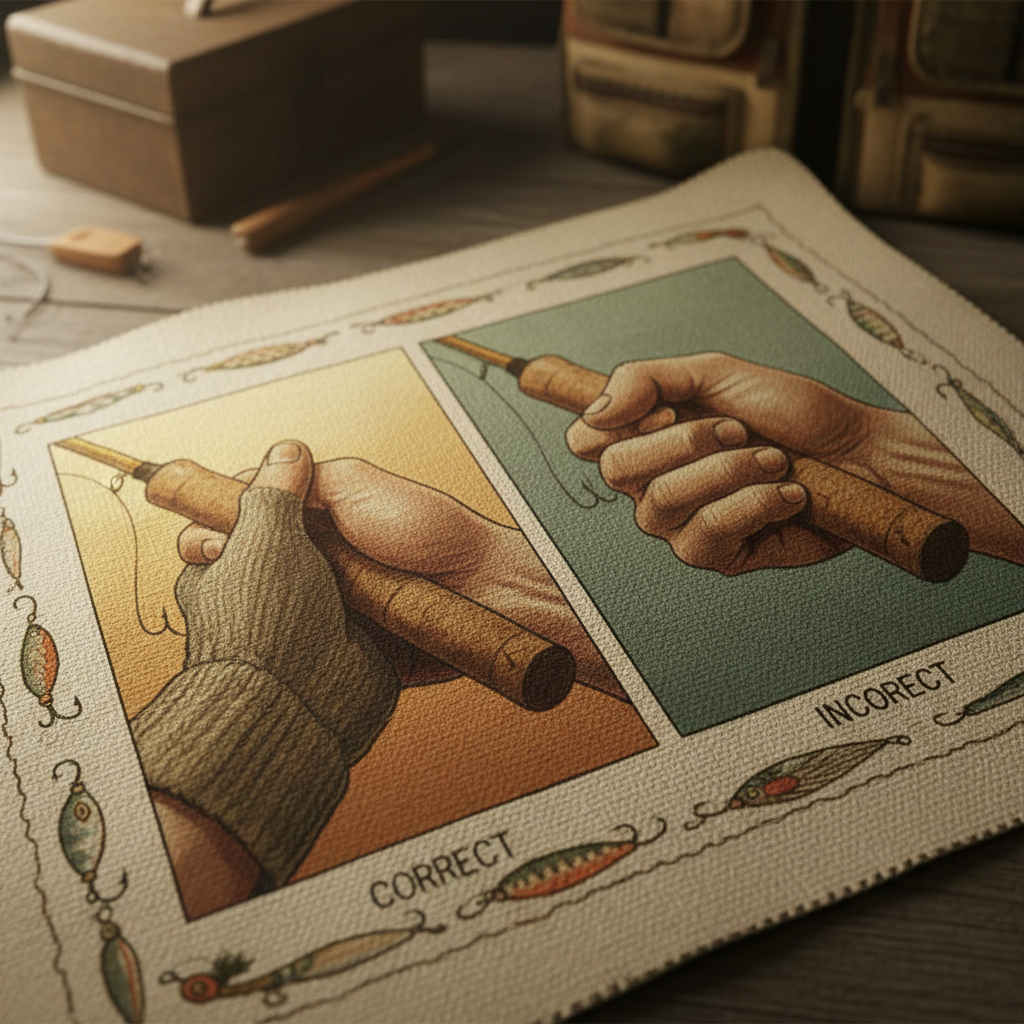
Perhaps the most prevalent error is the “death grip.” This is where you clench the rod handle with excessive force, as if you’re trying to crush it. While it might feel secure, this grip actually hinders your sensitivity and control.
Why is it so bad? First, it restricts blood flow to your hand and forearm, leading to fatigue. Second, it deadens your sense of feel, making it harder to detect subtle bites. Third, it limits your ability to make quick, precise movements. Imagine trying to play a delicate piece on the piano with clenched fists – it’s simply impossible.
Instead, aim for a relaxed grip. Your fingers should be wrapped around the handle firmly enough to maintain control, but not so tightly that you’re straining. Think of holding a bird – you want to hold it securely, but not so tightly that you crush it.
The Thumb’s Tale: Where to Place Your Most Important Digit
The position of your thumb is often overlooked, but it plays a crucial role in both casting and retrieving. A common mistake is to wrap your thumb completely around the handle, similar to how you would hold a baseball bat. While this provides a sense of security, it limits your sensitivity and casting accuracy.
Instead, experiment with different thumb placements. For casting, try placing your thumb along the top of the handle, pointing towards the target. This allows you to apply more pressure during the cast and improves your accuracy. For retrieving, try placing your thumb slightly to the side of the handle. This can enhance your feel and provide more leverage when fighting a fish.
Ultimately, the best thumb position will depend on your individual preferences and the specific fishing technique you’re using. The key is to experiment and find what works best for you.
The Wrist Watch: Maintaining Flexibility and Control
Your wrist is another critical component of the grip. A stiff, locked wrist can severely limit your casting distance, hook-setting power, and overall control. Think of your wrist as a shock absorber, absorbing the vibrations of the rod and transmitting subtle movements.
Avoid locking your wrist in a fixed position. Instead, keep it loose and flexible, allowing it to move freely during the cast and retrieve. This will not only improve your performance but also reduce strain on your forearm and elbow.
A flexible wrist also allows you to impart more action to your lure. With a simple flick of the wrist, you can make your lure dance and entice even the most finicky fish.
The Art of the Adaptive Grip: Tailoring Your Technique
There’s no one-size-fits-all grip for every fishing situation. The optimal grip will vary depending on the type of fishing you’re doing, the size and weight of your lure, and the fighting style of the fish. Learning to adapt your grip to different situations is essential for maximizing your success.
Power vs. Finesse: Matching Your Grip to the Task
For power fishing techniques, such as cranking or jigging, a more secure grip is necessary. This allows you to generate more power during the hookset and maintain control over larger, more aggressive fish. A full-handed grip, with all fingers wrapped firmly around the handle, is often the best choice for these situations.
However, for finesse techniques, such as drop-shotting or shaky-heading, a lighter, more sensitive grip is required. This allows you to detect the most subtle bites and impart delicate movements to your lure. A split-grip, where your fingers are spread out along the handle, can enhance your feel and improve your presentation.
The Rod Matters: How Your Equipment Influences Your Grip
The type of rod you’re using will also influence your grip. A heavier rod will require a more secure grip than a lighter rod. Similarly, a rod with a longer handle will provide more leverage and allow you to use a wider variety of grips.
Consider the material of the rod handle as well. Some handles are made of cork, while others are made of foam or synthetic materials. Each material offers a different level of grip and sensitivity. Experiment with different handle materials to find what feels most comfortable and provides the best performance for you.
Fighting the Fish: Adjusting Your Grip Under Pressure
The moment you hook a fish, your grip will be put to the ultimate test. Maintaining a secure and controlled grip is essential for landing the fish, especially when dealing with larger or more powerful species.
As the fish fights, you may need to adjust your grip to maintain control. For example, if the fish is running away from you, you may need to tighten your grip to prevent it from stripping all the line off your reel. Conversely, if the fish is running towards you, you may need to loosen your grip to avoid putting too much strain on the line.
Learning to anticipate the fish’s movements and adjust your grip accordingly is a skill that comes with experience. The more you fish, the better you’ll become at reading the fish and responding instinctively.
Exercises and Drills for Grip Improvement
Improving your grip strength and dexterity can significantly enhance your fishing performance. Here are a few simple exercises and drills that you can incorporate into your routine:
The Squeeze: Building Hand and Forearm Strength
A simple yet effective exercise is the “squeeze.” Simply grab a tennis ball or stress ball and squeeze it as hard as you can for several seconds. Repeat this exercise several times throughout the day.
This exercise will help build strength in your hand and forearm muscles, which are essential for maintaining a secure grip on your fishing rod.
The Finger Roll: Enhancing Dexterity and Sensitivity
Another useful exercise is the “finger roll.” Hold a small object, such as a marble or a coin, in your palm and try to roll it around using only your fingers.
This exercise will improve your finger dexterity and sensitivity, which are crucial for detecting subtle bites and imparting delicate movements to your lure.
The Rod Hold: Practicing Proper Grip Technique
Finally, practice holding your fishing rod with the correct grip technique. Focus on maintaining a relaxed grip, proper thumb placement, and a flexible wrist.
Practice casting and retrieving with the correct grip, paying attention to how it feels. The more you practice, the more natural and comfortable the correct grip will become.

Case Studies: Real-World Examples of Grip Impact
Let’s look at a few real-world examples of how the grip can impact fishing success. These case studies illustrate the importance of proper grip technique and the consequences of common grip errors.
The Case of the Missed Hooksets: A Bass Fisherman’s Struggle
A bass fisherman was consistently missing hooksets, despite using sharp hooks and a sensitive rod. After observing his technique, it became clear that his grip was the culprit. He was using a “death grip,” clenching the rod handle with excessive force.
This restricted his sensitivity and prevented him from feeling the subtle bites of the bass. As a result, he was often setting the hook too late, after the fish had already spit out the lure.
By switching to a more relaxed grip, he was able to improve his sensitivity and detect bites earlier. This allowed him to set the hook more effectively and significantly increase his hookset ratio.
The Case of the Tired Angler: A Muskie Fisherman’s Fatigue
A muskie fisherman was experiencing severe fatigue in his hand and forearm after only a few hours of fishing. He was using a heavy rod and reel, and his grip was contributing to the problem.
He was wrapping his thumb completely around the handle, which put excessive strain on his forearm muscles. This led to fatigue and discomfort, making it difficult for him to fish effectively.
By adjusting his thumb position and using a more relaxed grip, he was able to reduce the strain on his forearm and fish for longer periods of time without experiencing fatigue.
The Case of the Lost Lure: A Trout Fisherman’s Casting Inaccuracy
A trout fisherman was struggling with casting accuracy, often missing his target by several feet. His grip was limiting his casting distance and control.
He was locking his wrist in a fixed position, which prevented him from generating enough power during the cast. This resulted in short, inaccurate casts.
By loosening his wrist and allowing it to move freely during the cast, he was able to improve his casting distance and accuracy. This allowed him to target specific areas of the river and catch more trout.
Advanced Grip Techniques: Taking It to the Next Level
Once you’ve mastered the basics of grip, you can start experimenting with more advanced techniques. These techniques can help you fine-tune your presentation, improve your hooksets, and ultimately catch more fish.
The Split Grip: Enhancing Sensitivity for Finesse Fishing
The split grip involves spreading your fingers out along the handle, with a gap between your index finger and middle finger. This grip enhances your sensitivity and allows you to feel even the most subtle bites.
The split grip is particularly useful for finesse fishing techniques, such as drop-shotting, shaky-heading, and Ned rigging. It allows you to detect the slightest movement of your lure and react quickly to bites.
The Two-Handed Grip: Maximizing Power for Heavy Cover
The two-handed grip involves using both hands to hold the rod, providing maximum power and control. This grip is particularly useful for fishing in heavy cover, where you need to be able to quickly pull fish away from snags and obstructions.
The two-handed grip can also be used for casting heavy lures or fighting large fish. It provides extra leverage and allows you to generate more power during the hookset.
The Modified Grip: Adapting to Specific Situations
The modified grip involves making slight adjustments to your grip based on the specific situation. For example, you might tighten your grip slightly when setting the hook or loosen your grip slightly when fighting a fish.
Learning to modify your grip based on the situation is a key skill for advanced anglers. It allows you to adapt to changing conditions and maximize your chances of success.

Beyond the Rod: The Connection to the Fish
Ultimately, the grip is more than just a way to hold the rod. It’s a connection to the fish, a way to feel its movements, and a means to communicate your intentions. When you master the art of the grip, you’ll not only catch more fish, but you’ll also develop a deeper appreciation for the sport.
The grip is the interface between you and the underwater world. It’s the point of contact where your skill, knowledge, and intuition come together to create a seamless connection with the fish. It’s where the magic happens.
Imagine the feeling of a subtle tap on your line, the almost imperceptible tug that signals a fish is investigating your lure. With a proper grip, you can feel this subtle movement and react instantly, setting the hook with precision and confidence.
Conversely, imagine the frustration of missing a bite because you couldn’t feel it, or losing a fish because you couldn’t control it. These are the consequences of a faulty grip, the missed opportunities that can haunt an angler for years.
So, the next time you’re out on the water, take a moment to focus on your grip. Pay attention to the pressure you’re applying, the position of your thumb, and the angle of your wrist. Experiment with different techniques and find what works best for you.
Remember, the grip is the foundation upon which your entire fishing technique is built. Master it, and you’ll unlock a whole new level of fishing success.
The Future of Fishing: Embrace the Grip
As fishing technology continues to evolve, the importance of fundamental skills like grip technique will only increase. New rods and reels may offer enhanced sensitivity and power, but they can’t compensate for a faulty grip.
In fact, these advancements may even amplify the impact of grip errors. A more sensitive rod will transmit even the most subtle vibrations, but if you’re using a “death grip,” you’ll still miss those crucial signals.
Therefore, it’s essential for anglers to embrace the grip and dedicate themselves to mastering this fundamental skill. By doing so, they’ll not only improve their fishing performance but also enhance their connection to the sport and the underwater world.
The future of fishing belongs to those who understand the importance of the grip and are willing to invest the time and effort to perfect it. Are you ready to take your fishing to the next level?

It’s not about expensive gear or secret spots; it’s about understanding the fundamentals and applying them with precision and consistency. The grip, often overlooked, is a powerful tool in your fishing arsenal. Master it, and you’ll unlock a whole new level of success and enjoyment on the water. You’ll find that you’re not just holding a rod; you’re holding the key to unlocking the secrets of the deep.