The Siren Song of Sonar: Are You Hearing What You Think You Are?
There’s a certain allure to technology, isn’t there? Especially when it promises to simplify a complex task, like finding fish in a vast, opaque underwater world. The fish finder, with its glowing screen and cryptic symbols, whispers promises of angling success. But what if that promise is, at least partially, a lie? What if your fish finder, instead of guiding you to a bounty, is subtly misleading you, painting a picture that’s more fiction than fact?
We invest in these devices, trusting them to be our underwater eyes. We pore over the readings, interpreting the blips and arches, convinced that we’re deciphering the secrets of the lake or ocean floor. But are we truly understanding what the fish finder is telling us? Or are we falling prey to its inherent limitations and, sometimes, outright deceptions?
This isn’t to say that fish finders are useless. Far from it. They are powerful tools that, when used correctly and understood thoroughly, can significantly improve your fishing game. However, it’s crucial to approach them with a healthy dose of skepticism and a deep understanding of their potential pitfalls. We need to move beyond blind faith and embrace critical thinking, learning to interpret the data with nuance and context.
Decoding the Deception: Common Ways Fish Finders Mislead
The ways in which a fish finder can mislead you are surprisingly varied. They range from simple misinterpretations of sonar returns to more complex issues related to transducer placement, water conditions, and even the behavior of the fish themselves. Let’s delve into some of the most common culprits behind inaccurate readings.
The “Fish Arch” Fallacy: Not Everything That Arches is a Fish
The iconic “fish arch” is perhaps the most recognizable symbol on a fish finder screen. It’s what we’re all looking for, the visual confirmation that a fish is present beneath the boat. However, the arch isn’t always what it seems. The shape of the arch is determined by the fish’s movement in relation to the sonar beam. A perfect arch occurs when a fish swims through the center of the beam, moving towards and then away from the transducer. But what happens if the fish only partially enters the beam, or swims parallel to it?
In these scenarios, you might see a partial arch, a straight line, or even a distorted blob. These readings can be easily misinterpreted as smaller fish, debris, or even bottom structure. Moreover, other objects besides fish can create arch-like shapes. Weeds, branches, and even changes in water density can produce sonar returns that mimic the appearance of a fish. The key is to look for other indicators, such as the strength and consistency of the signal, the depth at which it appears, and the surrounding environment. A single arch in an otherwise barren area is far less likely to be a fish than multiple arches clustered around a submerged tree.
Consider this example: You’re fishing a weedy lake, and your fish finder is showing numerous small arches near the bottom. Excited, you cast your line, only to retrieve a clump of weeds. The arches weren’t fish; they were simply the sonar reflecting off the dense vegetation. This is a common scenario, and it highlights the importance of understanding the limitations of the technology and the specific characteristics of the fishing environment.
The Size Deception: How Sonar Beam Angle Affects Readings
The size of the fish arch, or any sonar return, is not always an accurate representation of the actual size of the object. The sonar beam is cone-shaped, meaning that it widens as it travels deeper into the water. A fish located directly beneath the transducer will appear smaller than a fish of the same size located further away. This is because the sonar beam is intersecting a smaller portion of the fish’s body when it’s closer to the transducer.
Furthermore, the strength of the sonar return is affected by the fish’s orientation to the beam. A fish facing directly towards the transducer will produce a stronger signal than a fish facing sideways. This can lead to misinterpretations about the size and density of the fish population. You might overestimate the size of a few fish that are facing the transducer and underestimate the number of fish that are oriented differently.
Imagine you’re fishing a deep channel, and your fish finder is showing a few large arches near the bottom. You assume these are massive fish, perhaps trophy-sized catfish. However, what if these are actually smaller fish that are simply positioned in a way that maximizes their sonar return? You could be spending hours targeting these “monster” fish, only to be disappointed when you finally hook one and it turns out to be a fraction of the size you expected.

The Speed Deception: Ghost Returns and False Positives
Another common source of misinterpretation is the phenomenon of “ghost returns.” These are false readings that appear on the screen due to interference, signal reflections, or even the movement of the boat itself. Ghost returns can look like fish, baitfish schools, or even bottom structure, leading you to waste time and effort pursuing nonexistent targets.
One common cause of ghost returns is interference from other electronic devices, such as trolling motors or other fish finders. This interference can create random blips and lines on the screen that mimic the appearance of fish. Another cause is signal reflection. The sonar signal can bounce off the hull of the boat or other objects in the water, creating false images on the screen. The movement of the boat can also contribute to ghost returns. As the boat rocks and rolls, the transducer’s angle changes, causing the sonar signal to distort and create false readings.
Consider this scenario: You’re trolling slowly along a shoreline, and your fish finder is showing a dense school of baitfish just ahead. Excited, you speed up and cast your line, only to find nothing. The baitfish school was a ghost return, caused by the reflection of the sonar signal off the hull of your boat. This is a frustrating experience, but it’s a common one, and it underscores the importance of being able to distinguish between genuine sonar returns and false positives.
The Bottom Deception: Hard vs. Soft Bottoms and Their Impact
The type of bottom you’re fishing over can also significantly affect your fish finder readings. Hard bottoms, such as rock or gravel, reflect the sonar signal strongly, producing a thick, well-defined line on the screen. Soft bottoms, such as mud or sand, absorb more of the signal, resulting in a thinner, less distinct line. These differences can impact your ability to identify fish and other objects near the bottom.
For example, a fish lying on a hard bottom will produce a strong sonar return, making it easy to detect. However, a fish lying on a soft bottom might be partially obscured by the weaker signal, making it more difficult to see. Moreover, soft bottoms can sometimes create a “fuzzy” appearance on the screen, making it harder to distinguish between fish and sediment.
Let’s say you’re fishing a lake with a mix of hard and soft bottoms. Your fish finder is showing a lot of fish arches in the areas with hard bottoms, but very few in the areas with soft bottoms. You might assume that the fish are simply preferring the hard bottom areas. However, it’s possible that there are just as many fish in the soft bottom areas, but they’re simply harder to detect due to the weaker sonar signal. This is why it’s important to understand the bottom composition and adjust your interpretation of the fish finder readings accordingly. Experiment with different gain settings to see if you can improve the visibility of fish in soft bottom areas.
Beyond the Screen: External Factors Influencing Accuracy
It’s not just the fish finder itself that can lead to misleading information. External factors, such as water conditions, transducer placement, and even your own fishing habits, can also play a significant role in the accuracy of your sonar readings.
Water Clarity and Thermoclines: The Invisible Barriers
Water clarity has a direct impact on the range and clarity of your fish finder. In clear water, the sonar signal can travel further and produce sharper images. In murky or stained water, the signal is attenuated, reducing its range and clarity. This can make it more difficult to detect fish, especially at greater depths.
Thermoclines, which are layers of water with rapidly changing temperatures, can also interfere with sonar signals. The difference in density between the warm and cold water layers can cause the signal to refract, creating distorted images on the screen. This can make it difficult to accurately identify fish or bottom structure near the thermocline.
Imagine you’re fishing a deep lake with a strong thermocline. Your fish finder is showing a lot of clutter and distortion near the thermocline, making it difficult to see anything clearly. You might assume that there are no fish in this area, but it’s possible that they’re simply obscured by the thermocline. In these situations, it’s helpful to experiment with different frequency settings. Higher frequencies provide better resolution but have a shorter range, while lower frequencies penetrate deeper but offer less detail. Adjusting the frequency can help you to cut through the clutter and see what’s really there.
Transducer Placement: The Key to Clear Communication
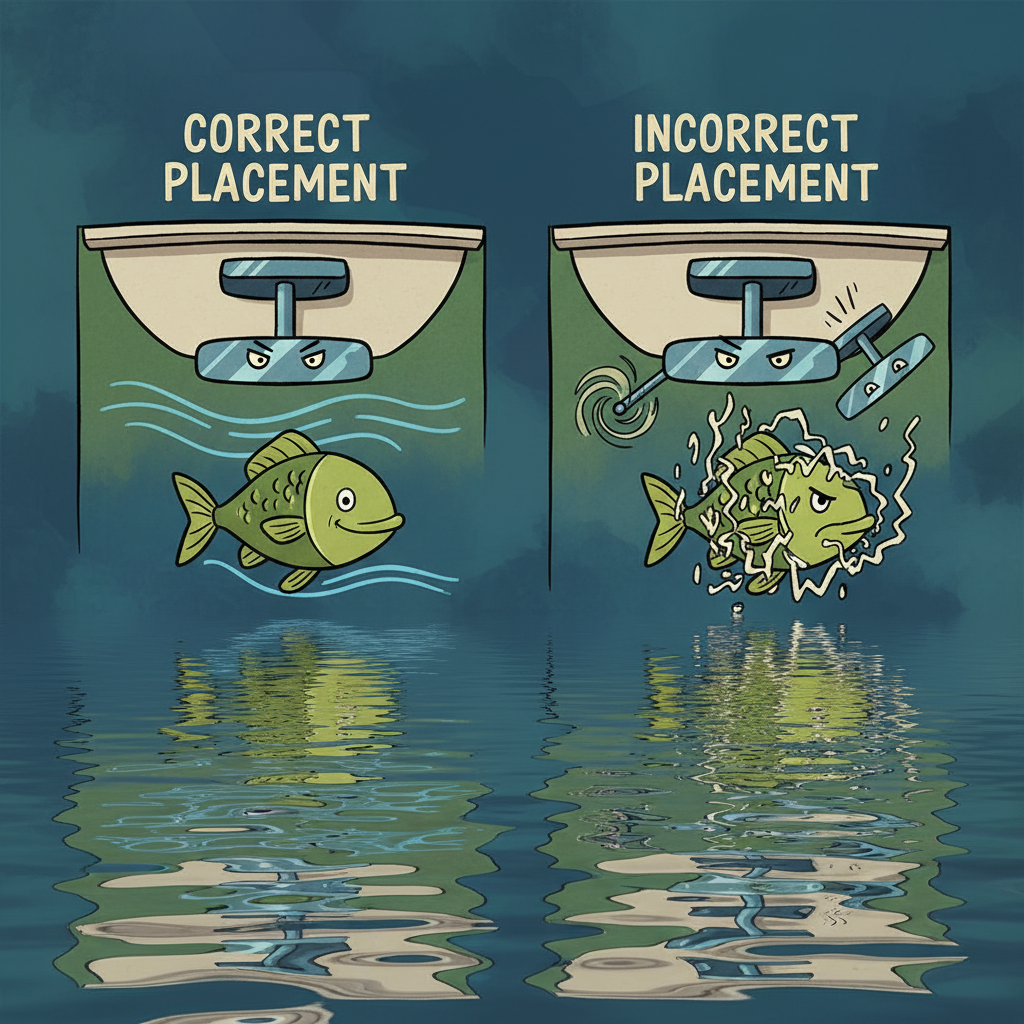
The placement of your transducer is crucial for obtaining accurate and reliable fish finder readings. The transducer should be mounted in a location that is free from obstructions and turbulence, and it should be properly aligned with the bottom of the boat. An improperly mounted transducer can produce distorted images, inaccurate depth readings, and even complete signal loss.
For example, if the transducer is mounted too close to the propeller, it can pick up interference from the propeller’s cavitation, creating a lot of noise on the screen. If the transducer is mounted at an angle, the sonar beam will be skewed, resulting in inaccurate depth readings and distorted images. The best location for a transducer is typically on the transom of the boat, away from any obstructions and in an area of smooth water flow. Consult your fish finder’s manual for specific recommendations on transducer placement.
The Human Factor: Biases and Assumptions
Perhaps the most significant factor influencing the accuracy of your fish finder readings is the human element. Our own biases, assumptions, and fishing habits can lead us to misinterpret the data and draw inaccurate conclusions. We tend to see what we want to see, and we often interpret the readings in a way that confirms our pre-existing beliefs.
For example, if you’re convinced that there are big fish in a particular area, you might be more likely to interpret ambiguous sonar returns as large fish arches, even if they could be something else. Or, if you’re having a slow day, you might be tempted to blame the fish finder for providing inaccurate information, rather than acknowledging that the fish simply aren’t biting.
To overcome these biases, it’s important to approach the fish finder with a critical and objective mindset. Don’t jump to conclusions, and be willing to consider alternative interpretations of the data. Compare your fish finder readings with other sources of information, such as fishing reports, weather conditions, and your own past experiences. The more information you have, the better equipped you’ll be to make informed decisions about where and how to fish.
Mastering the Machine: Tips for Accurate Interpretation
So, how can you minimize the chances of being misled by your fish finder and maximize its potential as a valuable fishing tool? Here are some practical tips for accurate interpretation:
Know Your Equipment: Read the Manual!
This may seem obvious, but many anglers fail to thoroughly read and understand their fish finder’s manual. The manual contains valuable information about the device’s features, settings, and limitations. It also provides guidance on how to interpret the sonar readings and troubleshoot common problems. Take the time to read the manual carefully, and refer to it often as you gain experience with the fish finder.
Experiment with Settings: Gain, Frequency, and More
Fish finders offer a wide range of settings that can be adjusted to optimize performance in different conditions. Experiment with these settings to find the combination that works best for you. Gain controls the sensitivity of the sonar receiver. Increasing the gain will amplify weak signals, making it easier to detect small fish or objects. However, too much gain can also amplify noise and clutter, making it harder to distinguish between genuine returns and false positives. Frequency determines the resolution and range of the sonar signal. Higher frequencies provide better resolution but have a shorter range, while lower frequencies penetrate deeper but offer less detail. Adjusting the frequency can help you to cut through clutter, see through thermoclines, and identify fish in different types of environments.
Cross-Reference Your Data: Use Multiple Sources
Don’t rely solely on your fish finder for information. Use other sources, such as fishing reports, weather conditions, and your own past experiences, to corroborate your findings. If the fish finder is showing a lot of fish in an area where you’ve never caught anything before, be skeptical. Check the fishing reports to see if other anglers have been successful in that area. Consider the weather conditions, such as wind, temperature, and cloud cover, which can affect fish behavior. Use your own past experiences to guide your decisions. If you’ve consistently caught fish in a particular area in the past, you’re more likely to catch them there again in the future.
Trust Your Instincts: The Angler’s Intuition
While technology can be a valuable tool, it’s important to remember that fishing is also an art. Develop your own angler’s intuition, and learn to trust your gut feelings. If something doesn’t feel right, don’t ignore it. If the fish finder is showing a lot of fish, but you’re not getting any bites, try a different technique or move to a different location. Sometimes, the best way to catch fish is to simply go with your instincts.

Case Studies: Real-World Examples of Fish Finder Misinterpretations
To further illustrate the potential for fish finder misinterpretations, let’s examine a few real-world case studies.
The Case of the Phantom Bass: A Tournament Angler’s Frustration
A tournament angler was pre-fishing for an upcoming competition on a large reservoir. His fish finder was showing a massive school of fish suspended near a submerged bridge. He spent hours trying to catch these fish, but to no avail. He tried every lure in his tackle box, but nothing seemed to work. Frustrated, he eventually gave up and moved to a different location.
After the tournament, he spoke to another angler who had fished the same area. The other angler informed him that the “fish” he had been seeing were actually a school of shad. The tournament angler had been so focused on finding bass that he had completely overlooked the possibility that the sonar returns could be something else. This case study highlights the importance of considering all possible interpretations of the data, and not jumping to conclusions based on your pre-existing beliefs.
The Case of the Hidden Walleye: A Weekend Warrior’s Discovery
A weekend warrior was fishing for walleye on a deep, clear lake. His fish finder was showing a few small arches near the bottom, but he wasn’t getting any bites. He was about to give up when he decided to experiment with his gain settings. He increased the gain significantly, and suddenly, the screen lit up with a dense school of walleye. He had been overlooking the walleye because they were lying close to the bottom, and the sonar signal was too weak to detect them at the lower gain setting.
This case study demonstrates the importance of experimenting with your fish finder’s settings to optimize performance in different conditions. By increasing the gain, the angler was able to amplify the weak signals and reveal the hidden walleye.
The Case of the Misleading Structure: A Coastal Fisherman’s Lesson
A coastal fisherman was using his fish finder to locate promising bottom structure. He found a large, jagged structure on the screen and assumed it was a reef. He anchored his boat nearby and began fishing, but he didn’t catch anything. He moved around the structure, trying different locations and techniques, but still no luck.
Later, he consulted a nautical chart of the area and discovered that the “reef” he had been fishing was actually a sunken barge. The barge was made of metal, which reflected the sonar signal strongly, creating a misleading image on the screen. The fisherman had been wasting his time fishing around a structure that was unlikely to hold fish. This case study highlights the importance of cross-referencing your fish finder readings with other sources of information, such as nautical charts, to verify the accuracy of your findings.
The Future of Fish Finding: AI and Beyond
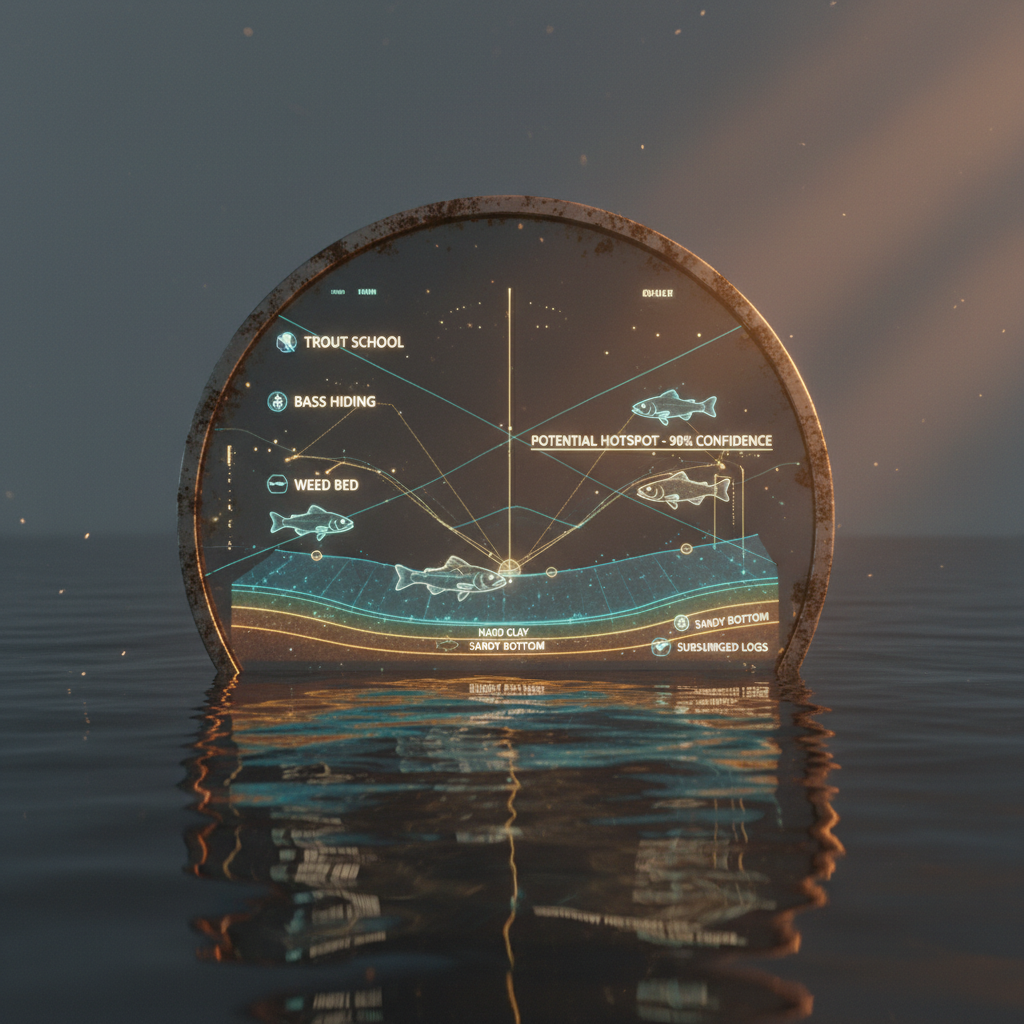
The technology behind fish finders is constantly evolving, with new features and capabilities being introduced all the time. One of the most promising developments is the integration of artificial intelligence (AI) into fish finder systems. AI algorithms can analyze sonar data in real-time, distinguishing between fish, structure, and clutter with greater accuracy than ever before. AI can also learn from past data and adapt to changing conditions, providing anglers with more personalized and relevant information.
Imagine a fish finder that can not only identify fish but also predict their behavior based on weather conditions, water temperature, and other factors. This is the promise of AI-powered fish finders, and it could revolutionize the way we fish in the future.
However, even with the advent of AI, it’s important to remember that fish finders are still just tools. They can provide valuable information, but they can’t guarantee success. The ultimate responsibility for catching fish still rests with the angler. We need to continue to develop our skills, knowledge, and intuition, and to use technology as a complement to, not a replacement for, our own angling abilities.
So, the next time you’re out on the water, staring intently at your fish finder screen, remember to take a step back and consider the bigger picture. Don’t be seduced by the siren song of sonar. Approach the data with a critical and objective mindset, and be willing to question what you’re seeing. Understand the limitations of the technology and the factors that can influence its accuracy. And most importantly, trust your own instincts and intuition. By doing so, you can unlock the true potential of your fish finder and become a more successful angler.