The Allure of the Unseen Catch
Fishing, at its core, is an act of faith. You cast your line into the water, a silent offering to the unknown depths, with the hope of enticing something unseen to rise and meet you. But what happens when the unseen catch, the actual fish, becomes less important than the act itself? When the rhythmic cast, the gentle rocking of the boat, and the vastness of the open water eclipse the desire for a trophy?
For many, fishing transcends the simple pursuit of aquatic life. It morphs into something deeper, a journey of self-discovery painted against the backdrop of nature’s grandeur. It’s about the quiet moments of contemplation, the connection with the environment, and the challenge of matching wits with a creature perfectly adapted to its domain. In these moments, the size of the fish becomes inconsequential. The true reward lies in the experience itself.
Think about it: how many times have you heard a seasoned angler recount a tale of the “one that got away” with more fondness than a story of a record-breaking catch? Why is it that those near misses, those moments of almost-triumph, often linger longer in our memories? Perhaps it’s because they represent the essence of the journey – the struggle, the anticipation, the humbling reminder that we are but a small part of a much larger world.
Beyond the Scales: Finding Meaning in the Mundane
We live in a society obsessed with quantifiable results. We measure success by metrics, achievements, and tangible rewards. But what about the immeasurable? The things that can’t be weighed or counted, but which hold immense value nonetheless?
Fishing, in its unhurried rhythm, offers a sanctuary from this relentless pursuit of achievement. It teaches us to appreciate the simple pleasures – the warmth of the sun on our skin, the sound of the waves lapping against the hull, the camaraderie of fellow anglers sharing stories and laughter. These seemingly mundane moments, when woven together, create a tapestry of experiences that enrich our lives far beyond the fleeting satisfaction of landing a trophy fish.
Consider the example of an elderly fisherman named Silas, who has spent his life casting his line into the same river. He’s caught his share of impressive fish over the years, but his most cherished memories aren’t about the size of his catches. They’re about the sunrises he’s witnessed, the wildlife he’s observed, and the friendships he’s forged along the riverbank. For Silas, the river is more than just a place to catch fish; it’s a living, breathing entity that has shaped his life and provided him with a sense of purpose.
The Education of Failure: Learning from Empty Hooks
Failure is an inevitable part of fishing. There will be days when the fish simply aren’t biting, when your best lures fail to entice, and when you return home empty-handed. But these days of perceived failure are often the most valuable learning experiences.
Each empty hook is a lesson in humility, a reminder that we are not always in control. It forces us to re-evaluate our strategies, to experiment with different techniques, and to deepen our understanding of the fish and their environment. It teaches us resilience, patience, and the ability to adapt to changing conditions.
Think of a young angler, eager to prove their skills, who spends an entire day without a single bite. Disappointment is natural, but the true measure of their character lies in how they respond to that disappointment. Do they give up in frustration, or do they use the experience as an opportunity to learn and grow? Do they analyze their mistakes, seek advice from more experienced anglers, and return to the water with a renewed sense of determination?
The education of failure extends beyond the realm of fishing. It teaches us valuable life lessons that can be applied to any challenge we face. It reminds us that success is not always guaranteed, and that setbacks are simply stepping stones on the path to mastery.
The Ethics of Angling: Respecting the Resource
As anglers, we have a responsibility to be stewards of the environment. We must recognize that the fish we pursue are a valuable resource, and that their survival depends on our responsible actions. This means practicing catch and release when appropriate, minimizing our impact on the ecosystem, and advocating for policies that protect our waterways.
The focus should always be on sustainability, ensuring that future generations have the opportunity to experience the same joys of fishing that we do. This requires a shift in mindset, from viewing fish as mere trophies to recognizing them as integral parts of a complex and delicate ecosystem.
Consider the example of a fishing club that actively participates in river cleanup efforts, removing trash and debris that pollutes the water and harms aquatic life. This is a tangible way to give back to the environment and demonstrate a commitment to responsible angling. It shows that the journey is not just about catching fish, but about preserving the resource for future generations.
The Community of Anglers: Sharing Stories and Building Bonds
Fishing is often perceived as a solitary pursuit, but it also has a strong sense of community. Anglers share a common passion, a language of lures and techniques, and a deep respect for the natural world. This shared connection fosters camaraderie and creates opportunities for meaningful relationships.
Whether it’s swapping stories around a campfire, offering advice to a novice angler, or simply sharing a knowing nod on the riverbank, the community of anglers provides a sense of belonging and support. It’s a place where egos are left behind, and where the focus is on shared experiences and mutual respect.
Think about the countless fishing forums and online communities where anglers from all walks of life come together to share their knowledge, ask questions, and celebrate each other’s successes. These virtual spaces provide a valuable resource for learning and connecting with like-minded individuals. They demonstrate that the journey is often more rewarding when shared with others.
The Art of Patience: Mastering the Waiting Game
Patience is a virtue, and nowhere is this more evident than in the art of fishing. It requires the ability to remain calm and focused, even when the fish aren’t biting. It teaches us to appreciate the present moment, to observe the subtle nuances of the environment, and to trust in the process.
The waiting game can be challenging, especially in our fast-paced, instant-gratification society. But it’s in those moments of stillness that we often gain the most profound insights. We learn to listen to the whispers of the wind, to watch the dance of the dragonflies, and to connect with our inner selves.
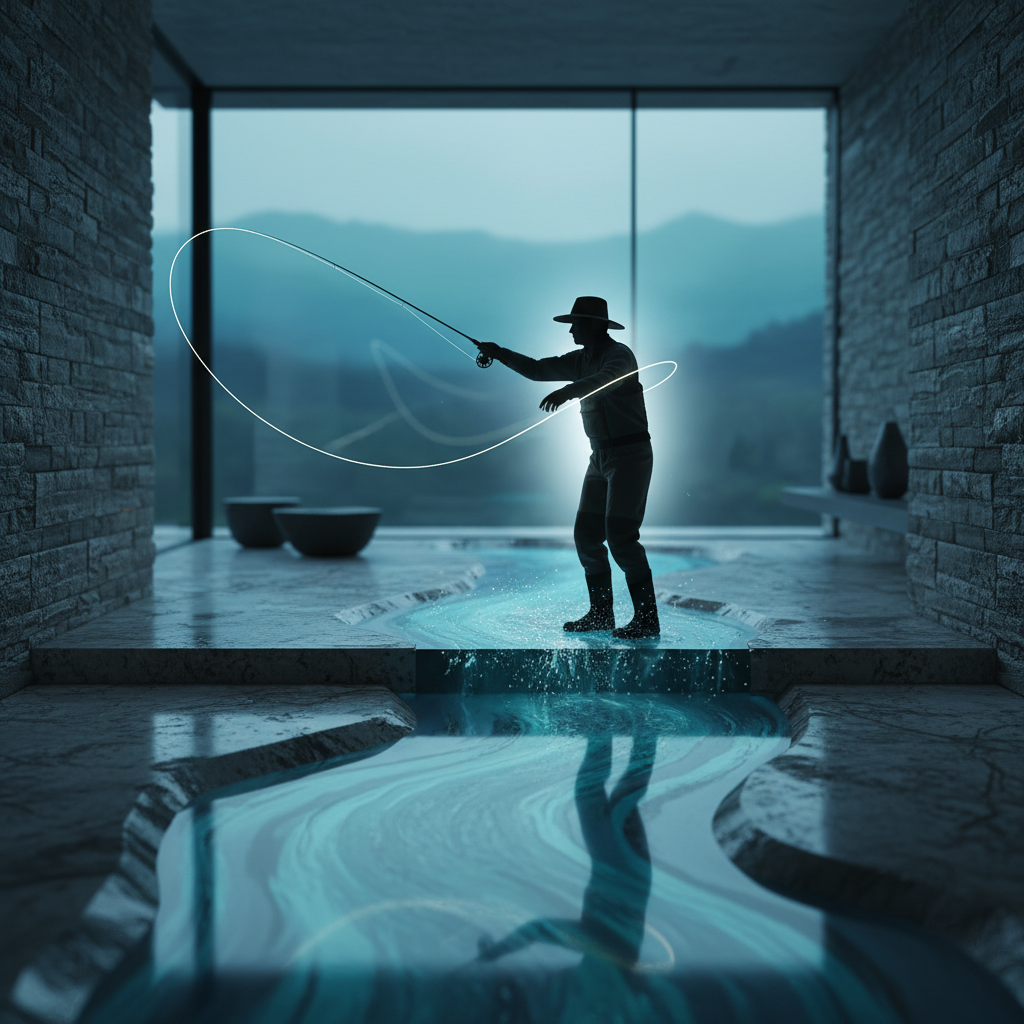
Imagine a fly fisherman standing waist-deep in a river, casting his line with meticulous precision. He may spend hours without a single strike, but he remains patient and focused, knowing that the opportunity will eventually present itself. It’s in that unwavering commitment to the process that he finds true satisfaction, regardless of whether he lands a fish.
Finding Flow: Losing Yourself in the Moment
The concept of “flow,” coined by psychologist Mihaly Csikszentmihalyi, describes a state of complete absorption in an activity, where time seems to disappear and the individual is fully immersed in the present moment. Fishing, with its inherent challenges and rewards, provides ample opportunities to enter this state of flow.
When we are truly engaged in the act of fishing, we lose ourselves in the details – the feel of the line in our hands, the movement of the lure in the water, the anticipation of the strike. We become one with the environment, attuned to the subtle cues that indicate the presence of fish.
This state of flow is not only enjoyable, but it also has numerous cognitive benefits. It can reduce stress, improve focus, and enhance creativity. It allows us to escape the distractions of everyday life and connect with something larger than ourselves.
Consider the example of a kayak fisherman paddling through a serene lake, casting his line with rhythmic precision. As he glides across the water, he becomes completely absorbed in the experience, losing track of time and forgetting about his worries. He is simply present, connected to the water, and attuned to the subtle movements of his kayak.
The Metaphor of the Line: Connecting to Something Bigger
The fishing line itself can be seen as a metaphor for our connection to the world around us. It represents the link between the angler and the fish, between the human and the natural, between the known and the unknown.
When we cast our line, we are extending ourselves into the unknown, reaching out to something beyond our immediate grasp. We are taking a risk, putting our trust in the potential for connection. And when we feel the tug of a fish on the line, we are experiencing a moment of profound connection, a reminder that we are all interconnected.
The line also represents the importance of patience, perseverance, and resilience. It can be easily broken, requiring us to be mindful and careful in our actions. It can be tangled and knotted, forcing us to untangle our thoughts and approach the situation with a clear mind.
Ultimately, the fishing line is a symbol of hope, a reminder that even in the vastness of the ocean, we can still find connection and meaning. It’s a testament to the power of human ingenuity and our innate desire to connect with the natural world.
The Legacy of the Journey: What We Take Away
In the end, the size of the fish we catch fades into insignificance compared to the memories we create, the lessons we learn, and the connections we forge along the way. The journey itself becomes the trophy, a testament to our resilience, our patience, and our unwavering connection to the natural world.
Fishing offers us a unique opportunity to escape the pressures of modern life and reconnect with our primal instincts. It teaches us to appreciate the simple pleasures, to embrace the challenges, and to find meaning in the mundane.
It reminds us that success is not always measured in quantifiable results, but rather in the richness of our experiences and the depth of our connections. It’s about the stories we tell, the friendships we cherish, and the legacy we leave behind.
So, the next time you cast your line into the water, remember that the journey is bigger than the trophy. Embrace the challenges, savor the moments, and allow yourself to be transformed by the experience. For it is in those quiet moments of contemplation, surrounded by the beauty of nature, that we truly discover ourselves. The true prize isn’t always the fish at the end of the line, but the experiences and lessons learned along the way, shaping us into better anglers, and ultimately, better human beings. The quiet solitude, the breathtaking scenery, and the challenge of the pursuit are often reward enough.