Unlocking the Aggression Code: The Secret to Consistent Strikes
Have you ever watched a seasoned angler consistently pull fish after fish from the same waters where you’re struggling to get a single bite? It’s a frustrating experience, leaving you wondering what secret knowledge they possess. While factors like location, time of day, and water conditions certainly play a role, there’s often a more subtle, yet incredibly powerful, element at play: understanding and triggering the predatory aggression of fish. It’s not just about presenting the right bait; it’s about presenting it in a way that ignites their primal instinct to strike.
Think of it like this: imagine you’re sitting down to a meal. A plate of bland, unseasoned food might satisfy your hunger, but a beautifully presented, aromatic dish is far more likely to tantalize your taste buds and make you truly enjoy the experience. Similarly, fish aren’t just looking for any easy meal; they’re driven by instinct and opportunity. By understanding what triggers their predatory aggression, you can transform a passive presentation into an irresistible invitation to attack.
The Science of the Strike: Understanding Predatory Behavior
To consistently trigger strikes, we need to delve into the fascinating world of fish behavior. Predatory aggression isn’t just random; it’s a complex interplay of instinct, learned behavior, and environmental cues. Fish are constantly evaluating their surroundings, assessing potential threats and opportunities. Several key factors influence their decision to strike:
* **Hunger:** Naturally, a hungry fish is more likely to strike than a satiated one. However, hunger alone isn’t enough. Even a hungry fish will be hesitant to strike if the presentation is unnatural or if it perceives a threat.
* **Territoriality:** Many fish species are fiercely territorial, especially during spawning season. They will aggressively defend their territory against intruders, even if they aren’t hungry.
* **Competition:** The presence of other fish can trigger a feeding frenzy. Fish are often more likely to strike when they perceive competition for food.
* **Curiosity:** Some fish are naturally curious and will investigate anything that seems out of the ordinary. This curiosity can be exploited by using lures with erratic actions or bright colors.
* **Threat:** Believe it or not, some fish will strike out of pure aggression or perceived threat, even if they are not actively hunting. A lure that encroaches on their space or mimics a predator can trigger a defensive strike.
Understanding these underlying motivations is the first step in unlocking the aggression code. It allows you to tailor your presentation to appeal to the specific instincts of the fish you’re targeting.
The “Trick”: Mastering the Art of the Tease
So, what’s the “trick” that makes fish attack your bait every time? It’s not a single technique, but rather a combination of strategies designed to mimic natural prey behavior and exploit the fish’s predatory instincts. At its core, it’s about mastering the art of the tease.
The goal is to create a presentation that is both enticing and slightly frustrating, triggering the fish’s impulse to strike before the opportunity disappears. This involves manipulating the lure’s movement, speed, and sound to create a sense of urgency and competition. Think of it like a cat playing with a toy mouse – the cat is driven by instinct to chase and pounce, even though it’s not truly hungry.
Here are some key elements of the “tease” technique:
* **Erratic Retrieval:** Instead of a steady, predictable retrieve, vary the speed and direction of your lure. Use pauses, twitches, and jerks to mimic the erratic movements of injured or fleeing prey.
* **Sudden Acceleration:** A sudden burst of speed can trigger a strike, especially from fish that are following the lure without committing. This simulates a prey animal attempting to escape, triggering the predator’s chase instinct.
* **Topwater Temptation:** With topwater lures, use a rhythmic cadence of pops, walks, or buzzes to create a disturbance on the surface. Vary the rhythm and intensity to mimic the sounds of feeding fish or struggling prey.
* **Structure Presentation:** Target areas where fish are likely to ambush prey, such as weed beds, submerged logs, and rocky outcroppings. Present your lure in a way that forces the fish to make a quick decision, increasing the likelihood of a reaction strike.
* **Color and Flash:** Use lures with colors and flash that are appropriate for the water conditions and the type of prey you’re mimicking. Brighter colors and more flash can be effective in murky water, while more natural colors are often better in clear water.
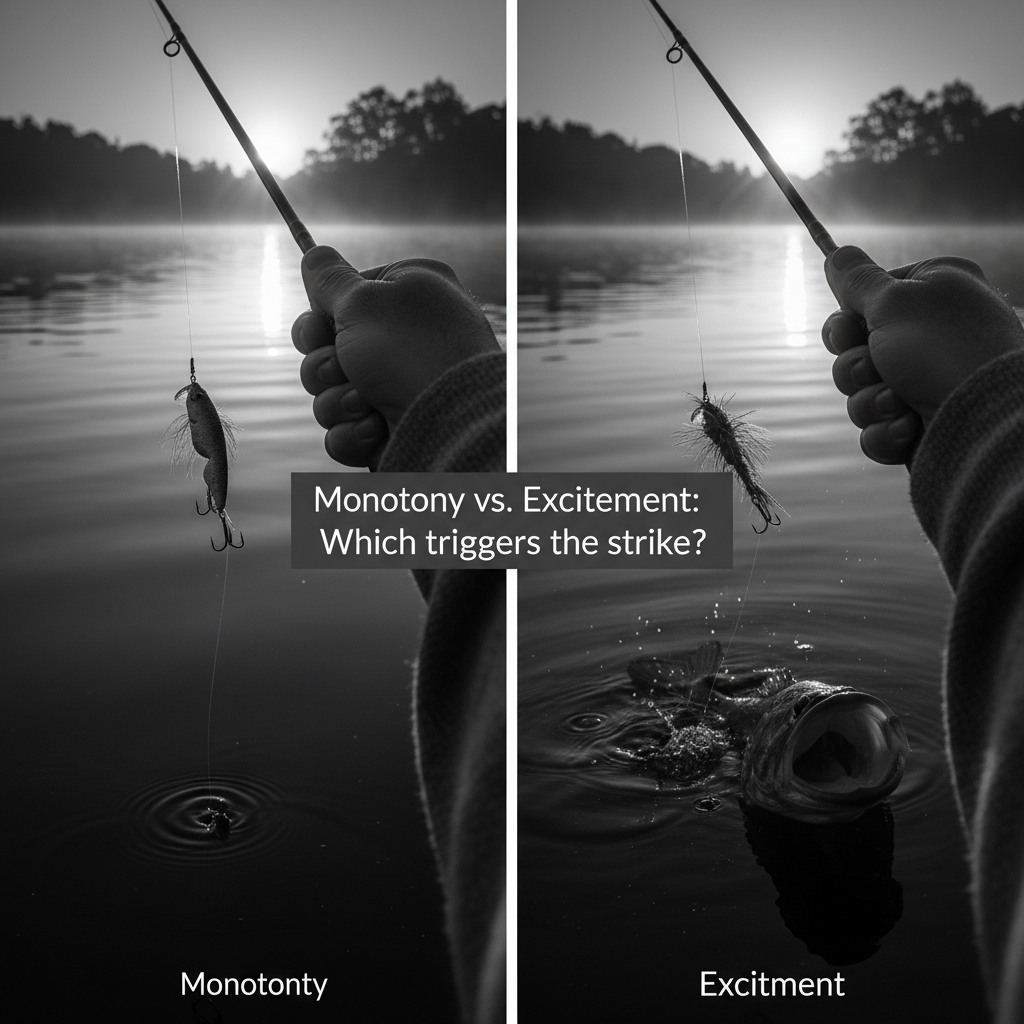
Case Study: Applying the Tease for Largemouth Bass
Let’s examine a specific example of how to apply the “tease” technique for largemouth bass, a popular and challenging target for many anglers. Largemouth bass are ambush predators, meaning they lie in wait for prey to come within striking distance. They are particularly fond of hiding in cover, such as weed beds, lily pads, and submerged timber.
To trigger a strike from a largemouth bass, consider the following scenario:
1. **Location:** You’re fishing a weedy lake with clear water. You notice a concentration of bass near a patch of lily pads.
2. **Lure Selection:** You choose a frog-style topwater lure, which mimics one of the bass’s favorite prey items.
3. **Presentation:** You cast the frog lure just past the edge of the lily pads and begin a slow, steady retrieve. However, you quickly realize that the bass aren’t showing any interest.
4. **The Tease:** Instead of continuing the monotonous retrieve, you switch things up. You start by popping the frog lure aggressively, creating a loud disturbance on the surface. You then pause for a few seconds, allowing the bass to hone in on the sound. Next, you twitch the lure erratically, mimicking the movements of a struggling frog. Finally, you speed up the retrieve slightly, creating the illusion that the frog is trying to escape.
5. **The Strike:** As you bring the frog lure past the edge of the lily pads, a massive largemouth bass explodes from the cover, engulfing the lure in a violent strike.
This example illustrates how the “tease” technique can transform a passive presentation into an irresistible invitation to attack. By varying the lure’s movement, speed, and sound, you create a sense of urgency and competition that triggers the bass’s predatory instincts.
Beyond the Basics: Fine-Tuning Your Approach
While the “tease” technique is a powerful tool, it’s important to remember that it’s not a one-size-fits-all solution. The most effective approach will vary depending on the specific species of fish you’re targeting, the water conditions, and the time of year. Here are some additional tips for fine-tuning your approach:
* **Observe and Adapt:** Pay close attention to the behavior of the fish and adapt your presentation accordingly. If the fish are hesitant to strike, try a different lure, retrieve, or presentation.
* **Experiment with Sound:** Sound can be a powerful trigger for predatory aggression. Experiment with different lures that produce different sounds, such as rattles, buzzers, and clickers.
* **Match the Hatch:** Pay attention to the natural prey items that are present in the water and try to mimic them as closely as possible.
* **Vary Your Retrieve:** Don’t be afraid to experiment with different retrieves until you find one that works. Try slow retrieves, fast retrieves, stop-and-go retrieves, and everything in between.
* **Focus on Structure:** Fish are often drawn to structure, such as weed beds, submerged logs, and rocky outcroppings. Focus your efforts on these areas, as they are likely to hold the most fish.
* **Consider Water Clarity:** Water clarity can significantly impact your lure selection and presentation. In clear water, use more natural colors and subtle retrieves. In murky water, use brighter colors and more aggressive retrieves.

The Mental Game: Patience and Persistence
Mastering the art of triggering predatory aggression requires not only technical skill but also a strong mental game. Fishing can be a challenging and unpredictable sport, and there will be times when you struggle to get a bite, even when you’re doing everything right. It’s important to remain patient and persistent, and to learn from your mistakes.
Don’t get discouraged if you don’t see immediate results. Keep experimenting with different techniques and presentations until you find something that works. Remember, even the most experienced anglers have days when they struggle to catch fish. The key is to stay positive, keep learning, and never give up.
Think of it like learning a musical instrument. You won’t become a virtuoso overnight. It takes dedication, practice, and a willingness to experiment. Similarly, becoming a master angler requires a commitment to continuous learning and improvement. Every fishing trip is an opportunity to learn something new, whether it’s about fish behavior, lure presentation, or the subtle nuances of the environment.
Ethical Considerations: Responsible Angling
As anglers, we have a responsibility to protect the resources we enjoy. It’s important to practice ethical angling techniques, such as catch-and-release, to ensure that fish populations remain healthy and sustainable.
Here are some tips for responsible angling:
* **Use Barbless Hooks:** Barbless hooks are easier to remove and cause less damage to the fish.
* **Handle Fish Gently:** When handling fish, wet your hands first to avoid removing their protective slime coating.
* **Minimize Air Exposure:** Keep fish in the water as much as possible to minimize stress.
* **Release Fish Quickly:** Release fish as quickly as possible to increase their chances of survival.
* **Follow Local Regulations:** Be aware of and follow all local fishing regulations, including size limits, bag limits, and closed seasons.
By practicing responsible angling, we can help ensure that future generations will have the opportunity to enjoy the sport of fishing.

Advanced Techniques: Taking It to the Next Level
Once you’ve mastered the basics of the “tease” technique, you can start experimenting with more advanced strategies to further enhance your success. These techniques require a deeper understanding of fish behavior and a greater level of skill and finesse.
* **Reading the Water:** Learning to “read the water” is essential for consistently finding fish. This involves paying attention to subtle clues, such as water clarity, current flow, and the presence of baitfish.
* **Understanding Seasonal Patterns:** Fish behavior changes throughout the year, depending on the spawning cycle, water temperature, and food availability. Understanding these seasonal patterns can help you predict where fish will be located and how they will be behaving.
* **Using Electronics:** Modern fish finders and GPS units can provide valuable information about the underwater environment, such as depth, structure, and the presence of fish. Learning to use these tools effectively can significantly improve your fishing success.
* **Mastering Different Lure Types:** Each type of lure has its own unique action and presentation. Mastering a variety of lure types will allow you to adapt to different fishing conditions and target different species of fish.
* **Developing a Personalized Approach:** Ultimately, the most effective fishing technique is the one that works best for you. Experiment with different strategies and develop a personalized approach that suits your individual skills and preferences.
The Future of Fishing: Innovation and Technology
The world of fishing is constantly evolving, with new technologies and techniques emerging all the time. From advanced sonar systems to innovative lure designs, the future of fishing is sure to be exciting.
One of the most promising areas of innovation is in the field of artificial intelligence (AI). AI-powered fish finders are already being developed that can analyze data from sonar and other sensors to identify fish species, size, and location with greater accuracy than ever before. AI can also be used to optimize lure presentation, by analyzing the fish’s behavior and adjusting the lure’s movement and speed accordingly.
Another exciting development is the use of virtual reality (VR) and augmented reality (AR) technologies in fishing. VR simulations can allow anglers to practice their skills in a realistic environment, while AR applications can provide real-time information about the underwater environment directly on their smartphone or tablet screen.
These technological advancements have the potential to revolutionize the way we fish, making it more efficient, more enjoyable, and more sustainable. However, it’s important to remember that technology is just a tool. The most important skills for any angler are still observation, adaptation, and a deep understanding of the natural world.

In conclusion, while there’s no single magic bullet, the “trick” to making fish attack your bait every time lies in understanding their predatory instincts and mastering the art of the tease. By creating a presentation that is both enticing and slightly frustrating, you can trigger their impulse to strike before the opportunity disappears. Couple this with patience, persistence, ethical angling practices, and a willingness to embrace new technologies, and you’ll be well on your way to becoming a more successful and responsible angler. Remember, fishing is a journey, not a destination. Enjoy the process of learning and discovery, and always respect the natural world. The more you understand the creatures you seek, the better you’ll become at eliciting the reaction you desire.