Navigating the Technological Waters: Avoiding Common Fishing Tech Mistakes
The world of fishing has undergone a seismic shift in recent years. Gone are the days of solely relying on intuition and rudimentary tools. We now live in an era where sophisticated technology promises to enhance our angling experience, increasing our chances of landing that trophy fish. Fish finders, GPS plotters, smart reels, and even drones have become commonplace in the arsenals of both recreational and professional anglers. But with this technological revolution comes a learning curve, a potential for missteps that can not only negate the benefits but also lead to frustration and wasted resources. Are we truly mastering these tools, or are we simply becoming slaves to their complexity? This article aims to navigate the often-turbulent waters of fishing tech, highlighting common mistakes and offering practical advice to ensure you’re maximizing your investment and, more importantly, enjoying your time on the water.
The Lure of the Latest and Greatest: Resisting the Hype
It’s easy to get caught up in the marketing blitz surrounding new fishing gadgets. Each year, manufacturers release a barrage of products promising unparalleled performance and guaranteed success. The allure of the “latest and greatest” can be strong, especially for those eager to improve their catch rates. However, blindly purchasing every new piece of tech without considering your specific needs and skill level is a recipe for disappointment.
Consider this: a seasoned bass fisherman, accustomed to using a basic fish finder, invests in a high-end sonar system with intricate side-scanning capabilities. Overwhelmed by the sheer volume of data presented on the screen, he spends more time fiddling with settings than actually fishing. The result? A frustrating day on the water and a nagging feeling that his old, simpler device was more effective.
The lesson here is to resist the hype. Before making a purchase, carefully evaluate your needs, fishing style, and the types of waters you typically fish. Read reviews, compare specifications, and, if possible, try out the equipment before committing to a purchase. Don’t let the promise of technological superiority cloud your judgment. Remember, the best tool is the one you can use effectively.
Understanding the Fundamentals: Ignoring the Basics
Fishing technology is meant to augment, not replace, fundamental fishing skills. A top-of-the-line fish finder won’t magically put fish in your boat if you don’t understand basic fish behavior, seasonal patterns, or effective lure presentation. Many anglers mistakenly believe that technology is a shortcut to success, neglecting the essential knowledge that forms the foundation of good angling.
Imagine a scenario where a fisherman relies solely on his GPS plotter to navigate to a known fishing spot. Upon arriving, he drops anchor and casts his line, expecting immediate results. However, he fails to consider factors such as current, wind direction, or the presence of baitfish. Consequently, he spends the entire day fishing in an unproductive area, despite being in the “right” location according to his GPS.
This illustrates the importance of combining technology with fundamental fishing knowledge. Use your fish finder to locate structure and identify fish, but also pay attention to environmental cues, observe fish behavior, and adjust your presentation accordingly. Learn to read the water, understand fish migration patterns, and master basic fishing techniques. Technology is a powerful tool, but it’s only effective when used in conjunction with a solid understanding of the fundamentals. Are you focusing too much on the bells and whistles and forgetting the core principles of angling?
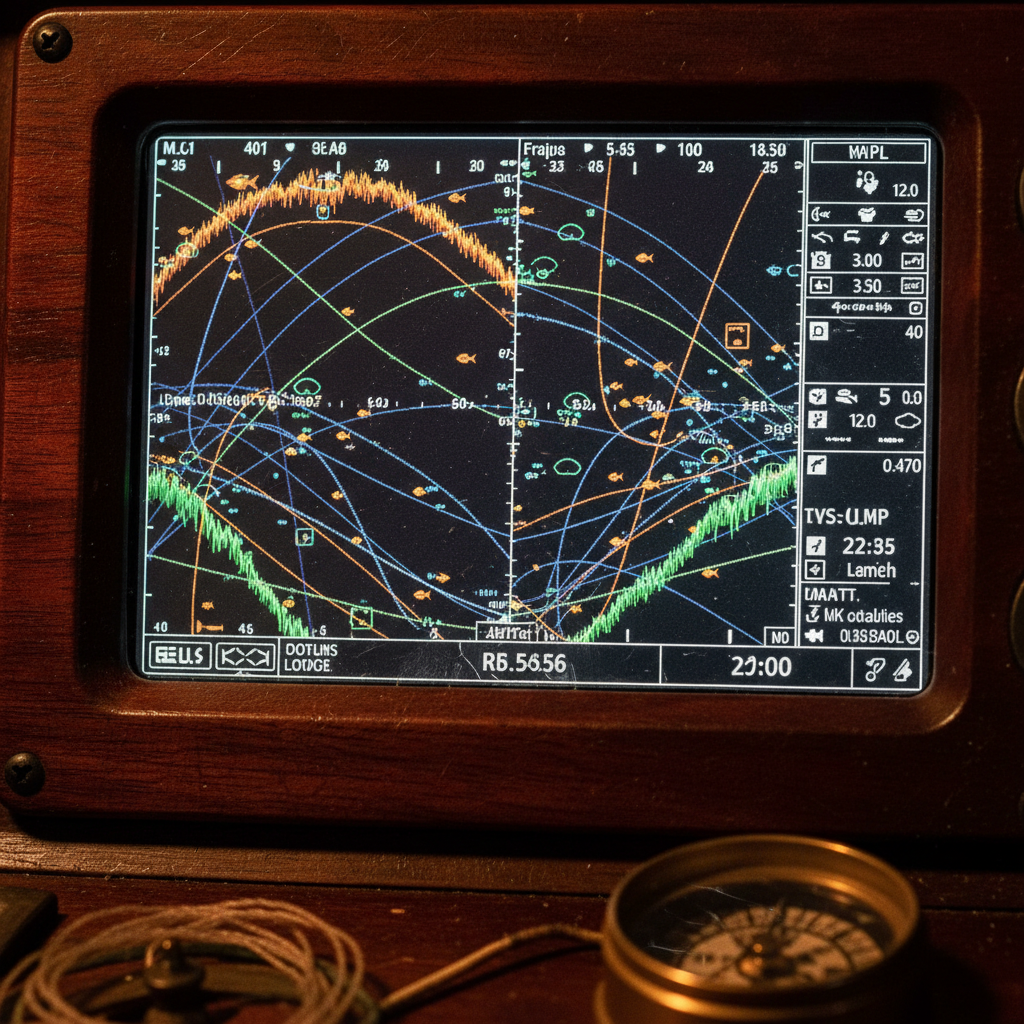
Decoding the Data: Misinterpreting Fish Finder Readings
One of the most common mistakes anglers make with fishing tech is misinterpreting the data displayed on their fish finders. Modern fish finders provide a wealth of information, including depth, water temperature, bottom composition, and the presence of fish. However, understanding what this data actually means and how to apply it to your fishing strategy is crucial.
Confusing Arches with Actual Fish: The Sonar Illusion
A classic example is the interpretation of sonar arches. Many anglers believe that every arch displayed on the screen represents a fish. While arches can indeed indicate the presence of fish, they can also be caused by other objects, such as submerged logs, rocks, or even air bubbles. Furthermore, the size and shape of the arch don’t necessarily correlate with the size of the fish. A small arch could represent a large fish passing quickly through the sonar beam, while a large, fuzzy arch could be a school of smaller fish.
To accurately interpret sonar readings, it’s essential to understand how sonar technology works. Sonar units emit sound waves that bounce off objects in the water. The time it takes for the sound waves to return to the transducer is used to calculate the distance to the object. The strength of the returning signal indicates the size and density of the object.
Instead of relying solely on arches, pay attention to other factors, such as the depth of the object, its proximity to structure, and its movement patterns. Experiment with different sonar settings to optimize the display for your specific fishing conditions. Practice interpreting sonar readings in various environments to develop a better understanding of what you’re seeing on the screen. Are you seeing what’s really there, or just what you want to see?
Ignoring Bottom Composition: The Hidden Clues
Another common mistake is overlooking the importance of bottom composition. Fish finders can provide valuable information about the type of bottom structure, such as rock, sand, mud, or vegetation. This information can be critical for locating fish, as different species prefer different types of habitat.
For example, bass often congregate around rocky structures, while catfish tend to prefer muddy bottoms. Crappie often seek shelter in submerged vegetation. By analyzing the bottom composition displayed on your fish finder, you can target areas that are most likely to hold fish.
Pay attention to the color and texture of the bottom displayed on your screen. Rock typically appears as a hard, jagged line, while sand appears as a smoother, more uniform line. Mud often appears as a weak, indistinct signal. Experiment with different frequency settings to enhance the detail of the bottom display.
The Case of the Phantom Fish: Sensitivity Settings and Noise
Incorrect sensitivity settings can also lead to misinterpretations. If the sensitivity is set too high, the fish finder may display excessive noise and clutter, making it difficult to distinguish between actual fish and false targets. Conversely, if the sensitivity is set too low, you may miss smaller fish or subtle changes in bottom composition.
Adjust the sensitivity settings based on the water conditions and the type of fishing you’re doing. In clear water, you can typically use a higher sensitivity setting. In murky water, you may need to reduce the sensitivity to minimize noise. Experiment with different settings until you find a balance that provides a clear and accurate display.
Powering Up: Battery Management and Maintenance
Fishing technology relies heavily on batteries, and proper battery management is crucial for ensuring that your equipment functions reliably throughout your fishing trip. Overlooking this aspect can lead to unexpected power failures and a frustrating day on the water.
The Forgotten Charge: Premature Battery Depletion
One of the most common mistakes is failing to fully charge batteries before heading out on the water. Many anglers assume that a quick charge is sufficient, only to discover that their batteries are depleted after a few hours of use. Always ensure that your batteries are fully charged before each trip, and consider carrying a spare battery as a backup.
Invest in a high-quality battery charger that is specifically designed for the type of battery you’re using. Avoid overcharging batteries, as this can damage them and shorten their lifespan. Follow the manufacturer’s instructions for charging and storing batteries.
The Wrong Battery Type: Compatibility Issues
Using the wrong type of battery can also cause problems. Different fishing devices require different voltage and amperage ratings. Using a battery that is not compatible with your equipment can damage the device or result in poor performance. Always check the manufacturer’s specifications to ensure that you’re using the correct type of battery.
Lithium-ion batteries are becoming increasingly popular for fishing applications due to their high energy density and long lifespan. However, they are also more expensive than traditional lead-acid batteries. Consider the trade-offs between cost, performance, and lifespan when choosing a battery type.

Corrosion and Connections: The Silent Killers
Corrosion is a common problem with marine batteries, especially in saltwater environments. Saltwater can corrode battery terminals and wiring, leading to poor connections and reduced performance. Regularly inspect your batteries for signs of corrosion and clean the terminals with a wire brush and baking soda solution.
Ensure that all connections are clean and secure. Loose connections can cause voltage drops and intermittent power failures. Apply a dielectric grease to the terminals to prevent corrosion and improve conductivity.
Storage Secrets: Extending Battery Life
Proper storage is essential for extending the lifespan of your batteries. When storing batteries for extended periods, disconnect them from the device and store them in a cool, dry place. Avoid storing batteries in direct sunlight or extreme temperatures.
Consider using a battery maintainer to keep your batteries charged during storage. Battery maintainers provide a low-current charge that prevents batteries from self-discharging and sulfating. Sulfation is a buildup of lead sulfate crystals on the battery plates, which can reduce battery capacity and lifespan. Are you treating your batteries like an afterthought, or are you giving them the care they deserve?
Calibration Catastrophes: Ensuring Accuracy and Reliability
Many fishing technologies, such as fish finders and GPS units, require periodic calibration to ensure accuracy and reliability. Neglecting this crucial step can lead to inaccurate readings and unreliable performance.
The Uncalibrated Compass: Navigational Nightmares
GPS units rely on accurate compass readings to determine your heading and direction. If the compass is not properly calibrated, it can provide inaccurate readings, leading to navigational errors. Calibrate your GPS compass regularly, especially after installing new batteries or moving the device to a different location on your boat.
Follow the manufacturer’s instructions for calibrating the compass. Typically, this involves rotating the device in a figure-eight pattern to allow it to detect the earth’s magnetic field. Ensure that there are no metal objects or electronic devices nearby that could interfere with the calibration process.
Frequency Fumbles: Fish Finder Fine-Tuning
Fish finders also require calibration to ensure accurate depth readings and fish detection. Calibrate your fish finder regularly, especially after changing transducers or fishing in different types of water.
Adjust the frequency settings to optimize the display for your specific fishing conditions. Higher frequencies provide more detail but have a shorter range. Lower frequencies provide less detail but have a longer range. Experiment with different frequency settings to find the best balance for your needs.
Software Slip-Ups: Staying Updated and Optimized
Software updates are essential for maintaining the performance and reliability of your fishing technology. Manufacturers regularly release updates that fix bugs, improve performance, and add new features. Install software updates as soon as they become available.
Check the manufacturer’s website for software updates and follow the instructions for installing them. Back up your data before installing updates to prevent data loss in case of a problem. Are you keeping your tech sharp, or letting it become dull and outdated?

Tech-Induced Tunnel Vision: Losing Sight of the Big Picture
Perhaps the most insidious mistake of all is allowing technology to distract you from the overall fishing experience. It’s easy to become so focused on the screens and gadgets that you lose sight of the natural world around you, the subtle cues that can lead you to success.
The Over-Reliance Trap: Missing the Obvious Signs
Many anglers become overly reliant on their fish finders, ignoring other important indicators of fish presence, such as bird activity, surface disturbances, or the presence of baitfish. These visual cues can often provide valuable information that is not readily apparent on a fish finder screen.
Pay attention to your surroundings and learn to read the water. Observe bird activity, look for surface disturbances, and check for the presence of baitfish. These clues can help you locate fish even without the aid of technology.
The Social Media Syndrome: Chasing the Likes, Not the Fish
Another common pitfall is spending too much time documenting your fishing trips on social media, rather than focusing on the actual fishing. While it’s great to share your experiences with others, don’t let social media become a distraction from the task at hand. Are you fishing for enjoyment, or fishing for validation?
Turn off your phone and disconnect from social media while you’re on the water. Focus on the present moment and immerse yourself in the fishing experience. Enjoy the beauty of nature, the challenge of the hunt, and the camaraderie of your fellow anglers.
The Human Element: Intuition and Experience Still Matter
Ultimately, fishing is more than just a technological exercise. It’s a blend of skill, knowledge, intuition, and experience. While technology can undoubtedly enhance your angling abilities, it should never replace the human element. Trust your instincts, learn from your mistakes, and never stop exploring the mysteries of the underwater world.
Remember the old adage: “Give a man a fish, and you feed him for a day. Teach a man to fish, and you feed him for a lifetime.” Technology can provide you with the fish, but it’s up to you to learn how to fish. Are you using technology to enhance your skills, or are you letting it replace them?

In conclusion, fishing technology offers incredible potential for enhancing our angling experiences, but it’s crucial to approach it with a balanced perspective. Avoid the hype, understand the fundamentals, interpret data accurately, manage batteries effectively, calibrate your equipment regularly, and never lose sight of the big picture. By avoiding these common mistakes, you can harness the power of technology to become a more successful and fulfilled angler. Embrace the tools, but never forget the essence of what makes fishing so rewarding: the connection with nature, the challenge of the hunt, and the joy of the catch. So, go forth, explore the technological waters, but always remember that the best fishing experience is one that combines technology with skill, knowledge, and a deep appreciation for the art of angling.