The Unseen Dance: Micro-Adjustments and Angling Success
In the world of sport fishing, where patience and precision intertwine, it’s not always the grand gestures that dictate triumph. Often, it’s the subtle, almost imperceptible, micro-adjustments that ultimately determine whether you land the fish of a lifetime or watch it swim away, a phantom of what could have been. We’re not just talking about casting technique or selecting the right lure; we’re diving into the art of reading the water, understanding the fish’s behavior, and responding with calculated, minute alterations to your approach. These seemingly insignificant tweaks can be the difference between a frustrating day on the water and a story you’ll recount for years to come.
Think of it like a seasoned musician fine-tuning their instrument. They don’t simply play the notes; they feel the vibrations, listen to the resonance, and make constant, microscopic adjustments to achieve perfect harmony. Similarly, the accomplished angler is perpetually attuned to the subtle cues of their environment, making real-time corrections to their technique based on a complex interplay of factors.
The Language of the Line: Feeling the Fight
The fishing line is more than just a connection between you and the fish; it’s a conduit for information, a tactile language that transmits the nuances of the underwater world directly to your fingertips. Learning to interpret this language is paramount to making effective micro-adjustments.
Consider the sensation of a fish taking your bait. Is it a tentative nibble, a sharp strike, or a steady pull? Each of these signals demands a different response. A tentative nibble might require a slight easing of the line, allowing the fish to take the bait more confidently. A sharp strike calls for an immediate and decisive hookset. A steady pull could indicate a larger fish that requires a more measured and controlled approach.
The texture of the bottom also plays a crucial role. Are you fishing over smooth sand, rocky terrain, or thick vegetation? Each environment presents unique challenges and requires different adjustments to your retrieve and presentation. Bumping your lure over rocks might trigger a strike from a lurking predator, while dragging it through weeds could result in a tangled mess. By paying close attention to the signals transmitted through the line, you can anticipate these challenges and adjust your technique accordingly.
Drag Dynamics: The Art of Give and Take
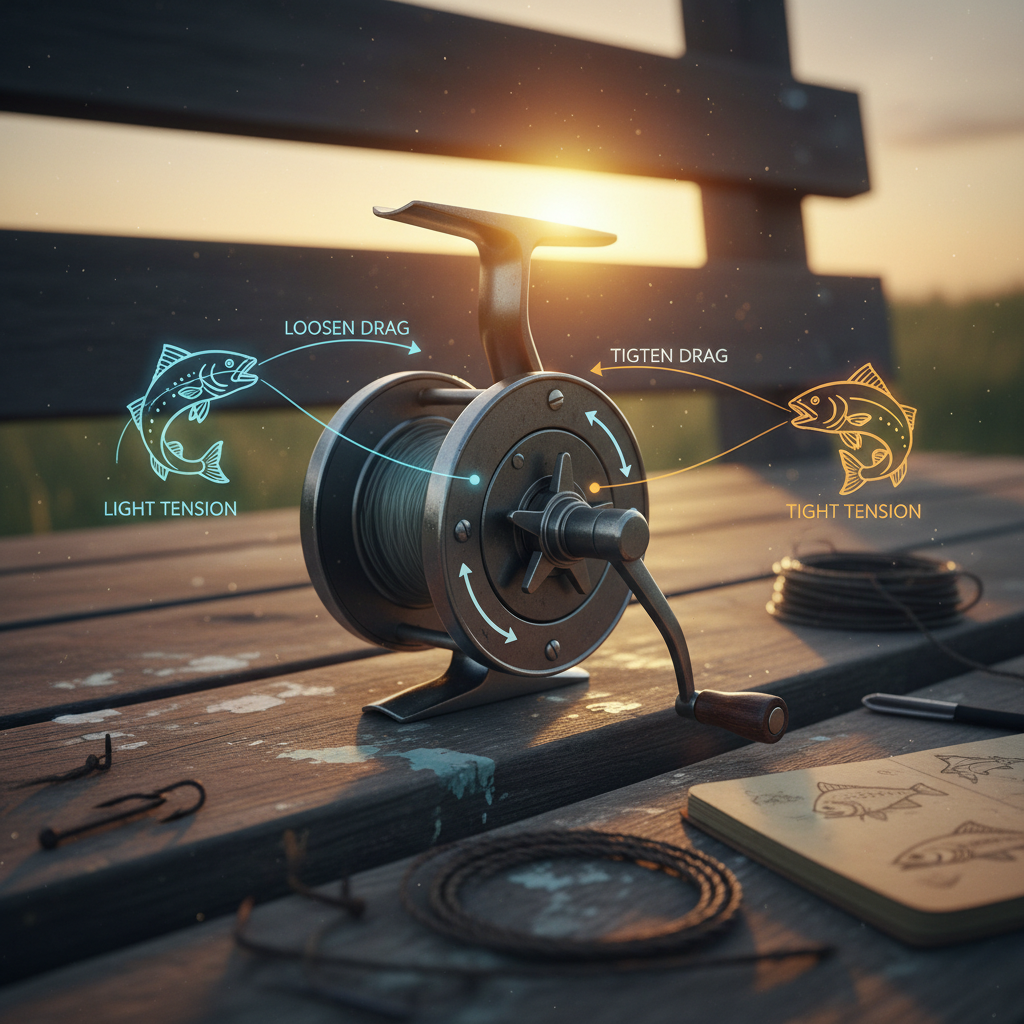
The drag setting on your reel is arguably one of the most critical components in the micro-adjustment arsenal. It’s the delicate balance between allowing the fish to run freely and applying enough pressure to keep it hooked. Too little drag and the fish could spool you, resulting in a lost fish and a tangled mess of line. Too much drag and you risk breaking the line or pulling the hook.
Finding the sweet spot requires a deep understanding of your equipment, the species you’re targeting, and the specific conditions you’re fishing in. A light drag setting might be appropriate for fishing for trout in a clear stream, where a delicate presentation is paramount. However, a heavier drag setting might be necessary when targeting powerful saltwater species like tuna or marlin.
The key is to constantly monitor the drag as the fight progresses and make subtle adjustments as needed. If the fish is making long, powerful runs, you might need to loosen the drag to prevent it from breaking the line. Conversely, if the fish is tiring and you need to gain ground, you can tighten the drag slightly to apply more pressure. This constant dance of give and take is what separates the skilled angler from the novice.
Bait Presentation: The Subtle Seduction
How you present your bait or lure is another area where micro-adjustments can make a significant difference. The goal is to make your offering as appealing as possible to the fish, mimicking its natural prey and triggering its predatory instincts.
This might involve adjusting the speed of your retrieve, the depth at which you’re fishing, or the action of your lure. For example, if you’re fishing for bass in a lake with clear water, you might want to use a slow, deliberate retrieve with a lure that has a subtle swimming action. This will give the bass a good look at the lure and entice it to strike.
On the other hand, if you’re fishing for pike in a murky river, you might want to use a fast, erratic retrieve with a lure that has a lot of vibration. This will help the pike locate the lure in the low visibility conditions and trigger a reaction strike.
The key is to experiment with different presentations until you find what works best for the given conditions. Don’t be afraid to try something new, even if it seems unconventional. Sometimes, the most unexpected adjustments can produce the most remarkable results.
Reading the Water: The Angler’s Sixth Sense
Beyond the mechanics of fishing, there’s a more intuitive aspect to making micro-adjustments – the ability to “read” the water. This involves observing the subtle cues of the environment and using them to inform your decisions.
Are there signs of feeding activity, such as birds diving or fish jumping? Is the water clear or murky? Is there a strong current or is the water still? All of these factors can influence the behavior of the fish and should be taken into account when making adjustments.
For example, if you notice a school of baitfish being chased by predators, you might want to switch to a lure that mimics the appearance and action of the baitfish. If the water is murky, you might want to use a lure that has a lot of vibration to help the fish locate it. If there’s a strong current, you might need to use a heavier weight to keep your bait in the strike zone.
Developing the ability to read the water takes time and experience, but it’s a skill that will greatly enhance your fishing success. It’s about becoming attuned to the rhythms of nature and using that knowledge to your advantage.
Case Studies: Micro-Adjustments in Action
To illustrate the importance of micro-adjustments, let’s examine a few real-world examples:
The Reluctant Trout: A Tale of Finesse
A fly fisherman was struggling to catch trout in a crystal-clear spring creek. He had tried a variety of flies, but nothing seemed to work. After observing the water for a while, he noticed that the trout were feeding on tiny midges. He switched to a smaller fly, but still no luck. Then, he realized that the trout were only taking the midges that were drifting naturally, without any drag. He made a subtle adjustment to his casting technique, ensuring that his fly drifted drag-free for as long as possible. Almost immediately, he started catching trout. The micro-adjustment in this case was not about the fly itself, but about the way it was presented.
The Deep-Sea Dance: Battling a Marlin
A group of anglers was deep-sea fishing for marlin. They hooked a large fish, but it was making long, powerful runs. The captain of the boat instructed the anglers to adjust the drag on their reels to prevent the marlin from breaking the line. As the fish tired, the anglers gradually tightened the drag, allowing them to gain ground. After a long and arduous battle, they were able to bring the marlin to the boat. The micro-adjustments in this case were critical to managing the fight and ultimately landing the fish.
The Bass Whisperer: Unlocking the Pattern
A bass fisherman was competing in a tournament on a large lake. He had been fishing all day without catching a single fish. In desperation, he decided to try something completely different. He started fishing a shallow, weedy area with a topwater frog lure. He noticed that the bass were only striking the lure when it was paused briefly over a patch of open water. He started making micro-adjustments to his retrieve, pausing the lure for slightly longer periods over the open water. This subtle change in technique proved to be the key to unlocking the pattern. He caught several large bass in the last hour of the tournament, earning him a place on the podium.

The Psychology of the Micro-Adjustment: Patience and Persistence
Mastering the art of micro-adjustments is not just about technical skill; it’s also about mental fortitude. It requires patience, persistence, and a willingness to experiment. There will be times when you feel like you’re doing everything right, but the fish still aren’t biting. Don’t get discouraged. Keep making small adjustments and eventually you’ll find what works.
It’s also important to be honest with yourself. If something isn’t working, don’t be afraid to admit it and try something else. The best anglers are those who are constantly learning and adapting. They’re not afraid to challenge their assumptions and try new approaches.
Think of it as a scientific experiment. You have a hypothesis (your initial approach), and you’re constantly testing it by making small adjustments. If the results aren’t what you expected, you modify your hypothesis and try again. This iterative process is what leads to breakthroughs and ultimately, to success.
Beyond the Catch: The Intrinsic Rewards
While landing a trophy fish is undoubtedly a rewarding experience, the true value of mastering micro-adjustments lies in the journey itself. It’s about developing a deeper understanding of the natural world, honing your observational skills, and cultivating a sense of patience and perseverance.
It’s about becoming a more attuned and responsive angler, capable of adapting to any situation and extracting success from even the most challenging conditions. It’s about the quiet satisfaction of knowing that you’ve put in the effort, paid attention to the details, and ultimately, outsmarted your quarry.
Fishing, at its core, is a conversation with nature. And like any good conversation, it requires active listening, thoughtful responses, and a willingness to adapt. The micro-adjustments you make are your way of contributing to that conversation, of showing that you’re paying attention and that you’re willing to learn.
Tools of the Trade: Gear That Enhances Sensitivity
While skill and experience are paramount, having the right equipment can certainly enhance your ability to make effective micro-adjustments. Modern fishing gear is designed to be more sensitive and responsive than ever before, allowing anglers to feel even the most subtle nuances of the underwater world.
Rods with high-modulus graphite blanks transmit vibrations more efficiently, allowing you to detect even the faintest bites. Reels with smooth drag systems allow you to make precise adjustments to line tension without risking a sudden surge of pressure. High-quality fishing line with low stretch provides a more direct connection to your lure, enhancing sensitivity and hooksetting power.
Investing in quality gear can be a worthwhile investment, but it’s important to remember that equipment alone is not enough. You still need to develop the skills and experience necessary to interpret the signals transmitted through your gear and make informed decisions.
The Future of Angling: Embracing Technology and Data
As technology continues to evolve, it’s likely to play an even greater role in the art of micro-adjustments. Sonar technology is becoming increasingly sophisticated, providing anglers with a detailed view of the underwater environment. GPS systems and electronic charts allow anglers to precisely mark and return to productive fishing spots. And data analytics tools can help anglers analyze their fishing data and identify patterns that might otherwise go unnoticed.
Imagine a future where anglers can use real-time data on water temperature, current, and fish behavior to make informed decisions about their fishing strategy. Imagine being able to use artificial intelligence to analyze your past fishing trips and identify the micro-adjustments that led to your greatest successes.
While technology can undoubtedly enhance our ability to make effective micro-adjustments, it’s important to remember that it’s just a tool. It’s still up to the angler to interpret the data and make the final decisions. The human element of fishing will always be essential, and the ability to read the water and understand the fish will remain the hallmarks of a truly skilled angler.
Beyond the Specifics: A Mindset of Continuous Improvement
Ultimately, the key to mastering micro-adjustments is to adopt a mindset of continuous improvement. Always be looking for ways to refine your technique, expand your knowledge, and enhance your understanding of the natural world.
Attend fishing seminars, read books and articles, and talk to other anglers. Experiment with different techniques and gear, and don’t be afraid to make mistakes. The more you practice and the more you learn, the better you’ll become at making the subtle, almost imperceptible, adjustments that can make all the difference.
Remember, fishing is a journey, not a destination. It’s about the constant pursuit of knowledge, the endless refinement of skill, and the deep connection with nature that it fosters. The micro-adjustments you make along the way are not just about catching fish; they’re about becoming a better angler, a more observant naturalist, and a more patient and persistent human being.

The pursuit of mastery in sport fishing, then, is not just about landing bigger fish or winning tournaments. It’s about embracing the challenge of continuous learning, honing your skills through diligent practice, and cultivating a deep respect for the aquatic environment. Each micro-adjustment, each subtle shift in strategy, represents a step further on this journey, transforming the simple act of fishing into a profound and rewarding experience. It’s a constant reminder that even the smallest details can have a monumental impact, both on and off the water.